
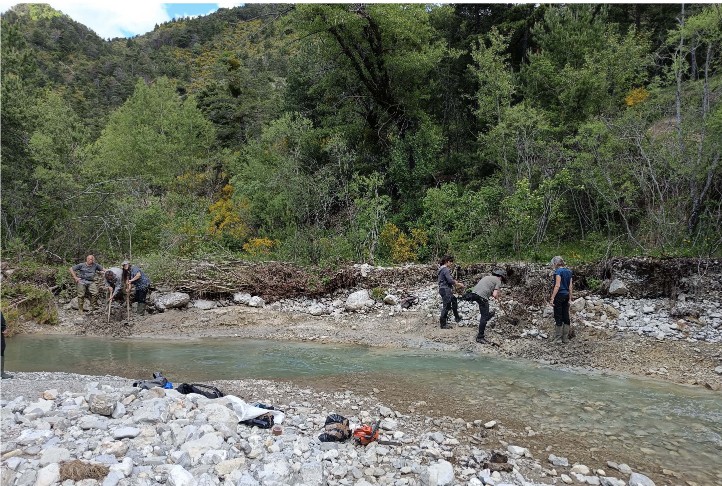
Subfossil pine trees from the Southern Alps reveal evidence of an exceptional solar event that occurred 14,300 years ago.
A study carried out by Edouard Bard, Cécile Miramont, Frauke Rostek, Thibaut Tuna, Frédéric Guibal, Christian Marschal and Timothy Heaton, highlights a extreme solar particle event which occurred around 14,300 years before the present, based on an analysis of subfossil pine trees preserved on the banks of the Drouzet in the French Alps.
Dendrochronological analyses, combined with high-precision radiocarbon measurements carried out at CEREGE, have made it possible to reconstruct nearly 700 years of records and to detect a sudden increase of approximately 30 ‰ in Δ¹⁴C.
This signature indicates an exceptional production of cosmogenic isotopes, consistent with an extremely intense episode of solar particle activity. Simulations of the carbon cycle, constrained in particular by ^10Be data from the GRIP ice core, support this interpretation.
Atmospheric models suggest that this event could be the most powerful extreme solar particle event identified to date, far exceeding the most significant cosmic-ray events recorded in recent decades.
These results thus show that subfossil trees can serve as genuine natural archives of past solar activity and enable us to document extreme solar events that occurred long before instrumental observations began.
A study which can be found in Philosophical Transactions of the Royal Society A : Radiocarbon dating of subfossil trees from the southern French Alps and the extreme solar particle event at approximately 14,300 cal yr BP